Here’s how our TPUs power increasingly demanding AI workloads.
Learn how Google’s TPUs power increasingly demanding AI workloads with this new video. ​Â
Here’s how our TPUs power increasingly demanding AI workloads. Read More »
Learn how Google’s TPUs power increasingly demanding AI workloads with this new video. ​Â
Here’s how our TPUs power increasingly demanding AI workloads. Read More »
Google has been a proud part of Austria’s landscape for years, and today, we’re announcing our first data center in Kronstorf, generating 100 direct jobs. This facility … ​Â
Elevating Austria: Google invests in its first data center in the Alps. Read More »
Many organizations are archiving large media libraries, analyzing contact center recordings, preparing training data for AI, or processing on-demand video for subtitles. When data volumes grow significantly, managed automatic speech recognition (ASR) service costs can quickly become the primary constraint on scalability. To address this cost-scalability challenge, we use the NVIDIA Parakeet-TDT-0.6B-v3 model, deployed through
Organizations are racing to deploy generative AI models into production to power intelligent assistants, code generation tools, content engines, and customer-facing applications. But deploying these models to production remains a weeks-long process of navigating GPU configurations, optimization techniques, and manual benchmarking, delaying the value these models are built to deliver. Today, Amazon SageMaker AIÂ supports
Amazon SageMaker AI now supports optimized generative AI inference recommendations Read More »
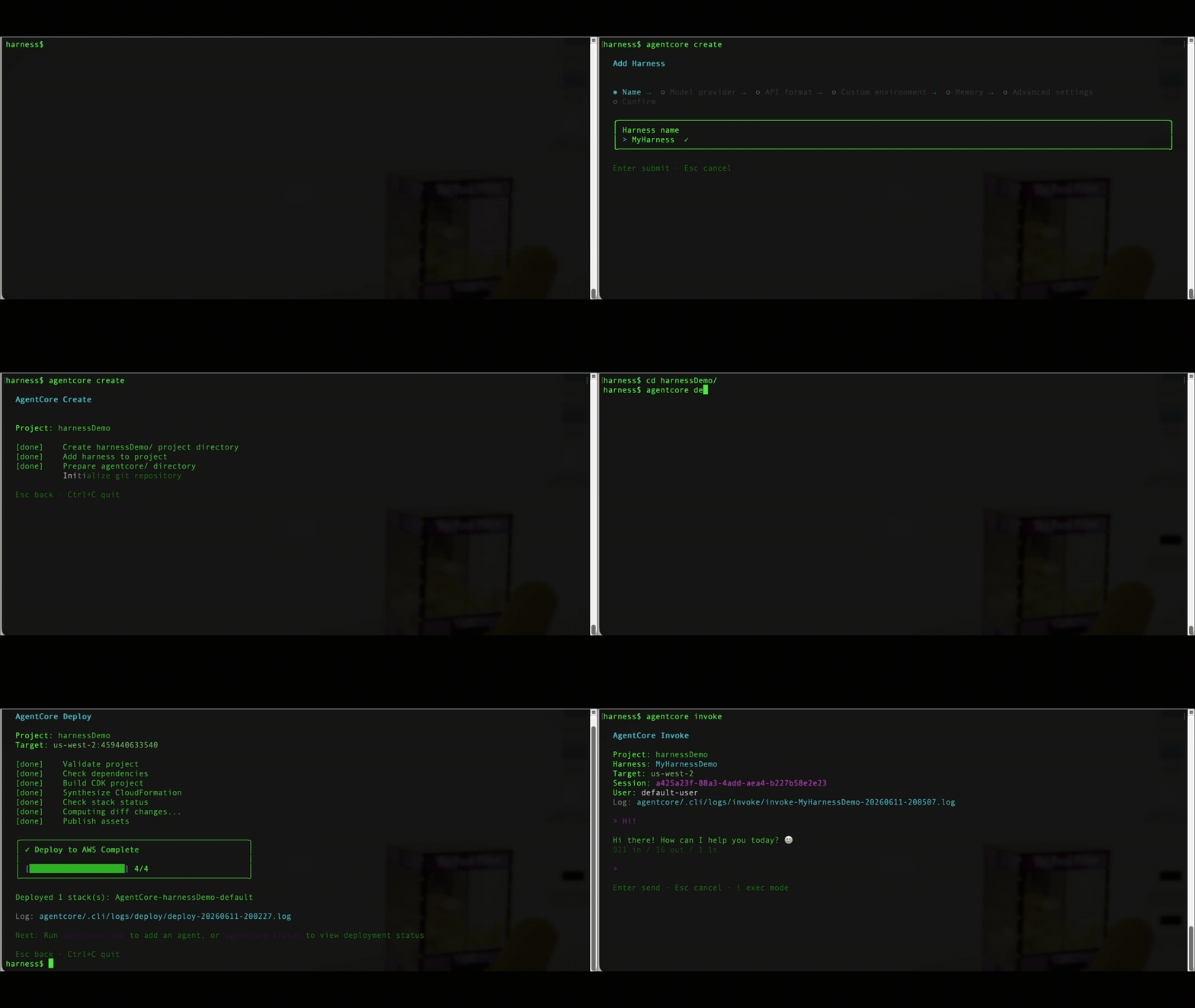
Getting an agent running has always meant solving a long list of infrastructure problems before you can test whether the agent itself is any good. You wire up frameworks, storage, authentication, and deployment pipelines, and by the time your agent handles its first real task, you’ve spent days on infrastructure instead of agent logic. We
This post is cowritten by Shawn Tsai from TrendMicro. Delivering relevant, context-aware responses is important for customer satisfaction. For enterprise-grade AI chatbots, understanding not only the current query but also the organizational context behind it is key. Company-wise memory in Amazon Bedrock, powered by Amazon Neptune and Mem0, provides AI agents with persistent, company-specific context—enabling
Company-wise memory in Amazon Bedrock with Amazon Neptune and Mem0 Read More »
The eighth generation of Google’s TPU includes two specialized chips that will power the future of AI. ​Â
We’re launching two specialized TPUs for the agentic era. Read More »
Today, we’re excited to announce Claude Cowork in Amazon Bedrock. You can now run Cowork and Claude Code Desktop through Amazon Bedrock, directly or using an LLM gateway. From startups to global enterprises across every industry, organizations build with Claude Code in Amazon Bedrock to boost developer productivity and accelerate delivery. With Amazon Bedrock you
From developer desks to the whole organization: Running Claude Cowork in Amazon Bedrock Read More »
Production machine learning (ML) teams struggle to trace the full lineage of a model through the data and the code that trained it, the exact dataset version it consumed, and the experiment metrics that justified its deployment. Without this traceability, questions like “which data trained the model currently in production?” or “can we reproduce the
End-to-end lineage with DVC and Amazon SageMaker AI MLflow apps Read More »
Three new agentic safety and policy features integrated into Ads Advisor will help protect and streamline your Google Ads account. ​Â
3 new ways Ads Advisor is making Google Ads safer and faster Read More »