Your marketing team loses hours to page assembly, coordination emails, and review cycles. These manual workflows keep teams from their most important work: identifying what problems customers face, crafting messages that resonate, and building campaigns that drive meaningful engagement.
In this post, we share how AWS Marketing’s Technology, AI, and Analytics (TAA) team worked with Gradial to build an agentic AI solution on Amazon Bedrock for accelerating content publishing workflows. The solution reduced webpage assembly time from up to four hours to approximately ten minutes (a reduction of over 95%) while maintaining quality standards across enterprise content management systems (CMS). Our marketing teams can now publish content faster and more consistently, freeing them to focus on finding more effective ways to reach and serve our customers. The solution can reduce manual effort, shorten review cycles, and improve content quality across our digital properties.
Marketing teams face a bottleneck where webpage publishing extends into hours of manual assembly, coordination, and review cycles. The TAA team transforms customer-facing web experiences by building and operating the digital content infrastructure of AWS, marketing technology workflows, and tooling that teams use to deliver personalized, connected experiences at scale. TAA needed a solution that could handle the complexity of CMS workflows while coordinating multiple stakeholders, enforcing brand and accessibility standards, and confirming compliance requirements are met before publication.
Marketing teams can use this agentic AI solution to reduce production time, while maintaining quality by automating the coordination work from campaign brief to go-live across digital channels. It connects to enterprise content management systems to orchestrate page assembly, interpret natural language requests, determine required components, and execute page creation with built-in validation. Using foundation models (FMs) available through Amazon Bedrock including Anthropic Claude and Amazon Nova, Gradial Agents modernize how marketing organizations work by handling the complex orchestration that previously required hours of manual configuration.
We walk through the challenges that traditional content publishing workflows face, the architecture of our agentic AI solution, key components including the Model Context Protocol (MCP) server for real-time validation, and the measurable results achieved.
Content publishing challenges
For Digital Marketing Managers (DMMs) and Product Marketing Managers (PMMs) at AWS, publishing a single webpage involves more than building it. A typical page starts with a requirement that stems from a campaign brief, moves through a kickoff call with the digital and operations teams, and enters a backlog for prioritization. Back-and-forth communication follows until the request is ready to be worked. A marketer spends up to four hours configuring pages inside traditional content management systems. Copy review, creative review, link testing, backend validation, and stakeholder sign-off add more time elapsed before launch. The bottleneck isn’t a single step, it’s how these steps compound. A DMM or PMM can configure components and assemble their page for multiple hours only to have an image fail accessibility standards. The page goes back for revision, and another review cycle begins. The work itself isn’t complex, but coordination and re-work make it expensive. Within that workflow, four specific challenges create the most friction:
- Long page assembly – Page creation involves configuring components, structuring layouts, and placing content within predefined frameworks. This work requires familiarity with structured CMS workflows and available component sets.
- Cross-team coordination delays – Teams typically review copy, assets, links, and integrations after the page is assembled. Issues identified at this stage require revisions and additional review cycles.
- Technical dependencies – When requirements go beyond existing components, teams work with engineering to implement updates, which can extend timelines and dependencies.
- Reactive quality control – Content health checks, accessibility compliance, brand standards, and SEO requirements are evaluated at the end of the process rather than during assembly. When issues are discovered only after pages are fully assembled, teams face costly rewrites and coordination delays that can extend timelines by hours or even days.
The AWS TAA team recognized that these weren’t isolated problems to solve individually. They were symptoms of a fundamental workflow issue: too much time spent on mechanical assembly, too little time available for the strategic work that moves the business forward. The solution needed to address page assembly first. This is where most of the time is spent and where coordination, dependencies, and validation requirements are introduced.
Solution overview
The agentic AI solution delivers three capabilities: natural language page assembly, real-time content validation, and end-to-end workflow execution in a single session. Gradial integrates with AWS MCP to handle real-time connections to enterprise content systems.
Natural language page assembly through Amazon Bedrock:
Marketers can describe the content and request actions to assemble a page in natural language. Gradial uses Amazon Bedrock models, including Anthropic Claude and Amazon Nova, to interpret that request to identify which components are needed, determine the correct layout structure, and generate the configurations. The system automates component selection and configuration through structured instructions passed to Gradial Agents, streamlining layout decisions that previously required specialized CMS knowledge. This lets content management teams assemble pages faster without deep technical expertise.
Real-time content quality validation through an MCP server:
Quality checks no longer wait until the end. MCP is an open protocol that allows AI systems to connect directly to external tools and data sources. In this solution, an MCP server connects to the content quality systems to validate content during assembly rather than after it. As content is created, the system evaluates it against SEO, accessibility, and brand standards (see Fig.1). Authors can identify and resolve issues immediately in the same session instead of waiting for a scheduled review meeting with the creative team, marketing operations, or other stakeholders days later.
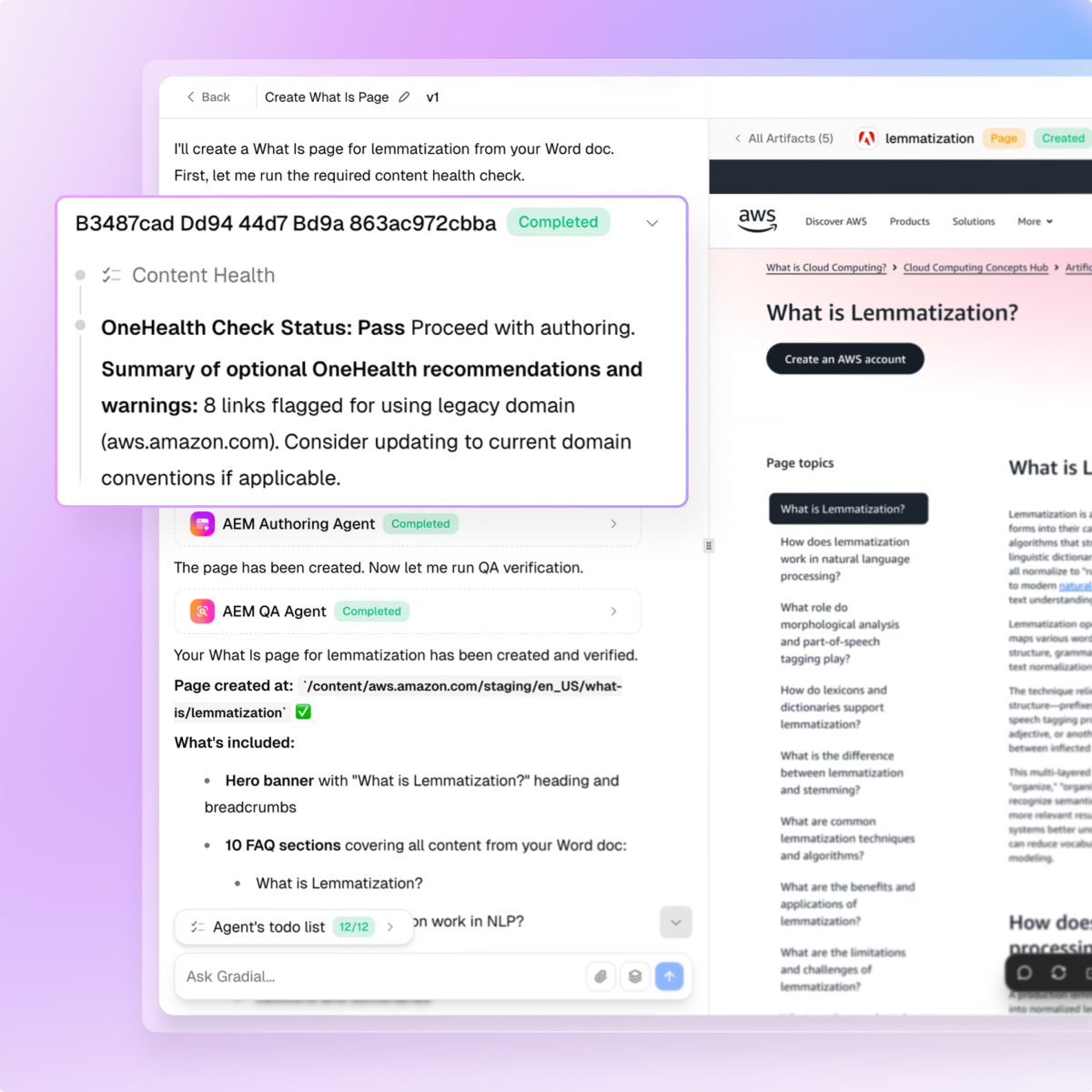
Fig. 1: Gradial invokes AWS health services to validate content against proprietary compliance and quality guidelines, SEO, accessibility, and brand standards. This real-time validation makes sure issues are identified and corrected early in the process, allowing users to address problems before proceeding with page assembly.
Direct CMS execution through a proxy layer:
A proxy layer connects Gradial to the CMS programmatically, allowing assembled pages to be created and configured within the content model and publishing workflows. Gradial sends structured instructions through the proxy layer, and the CMS handles page creation, component rendering, and publishing governance as it normally would. The proxy layer preserves the CMS’s role as the publishing system while reducing the need for manual authorization before publication. As a result, this reduces the coordination overhead by consolidating assembly, configuration, and handoff into a single automated workflow.
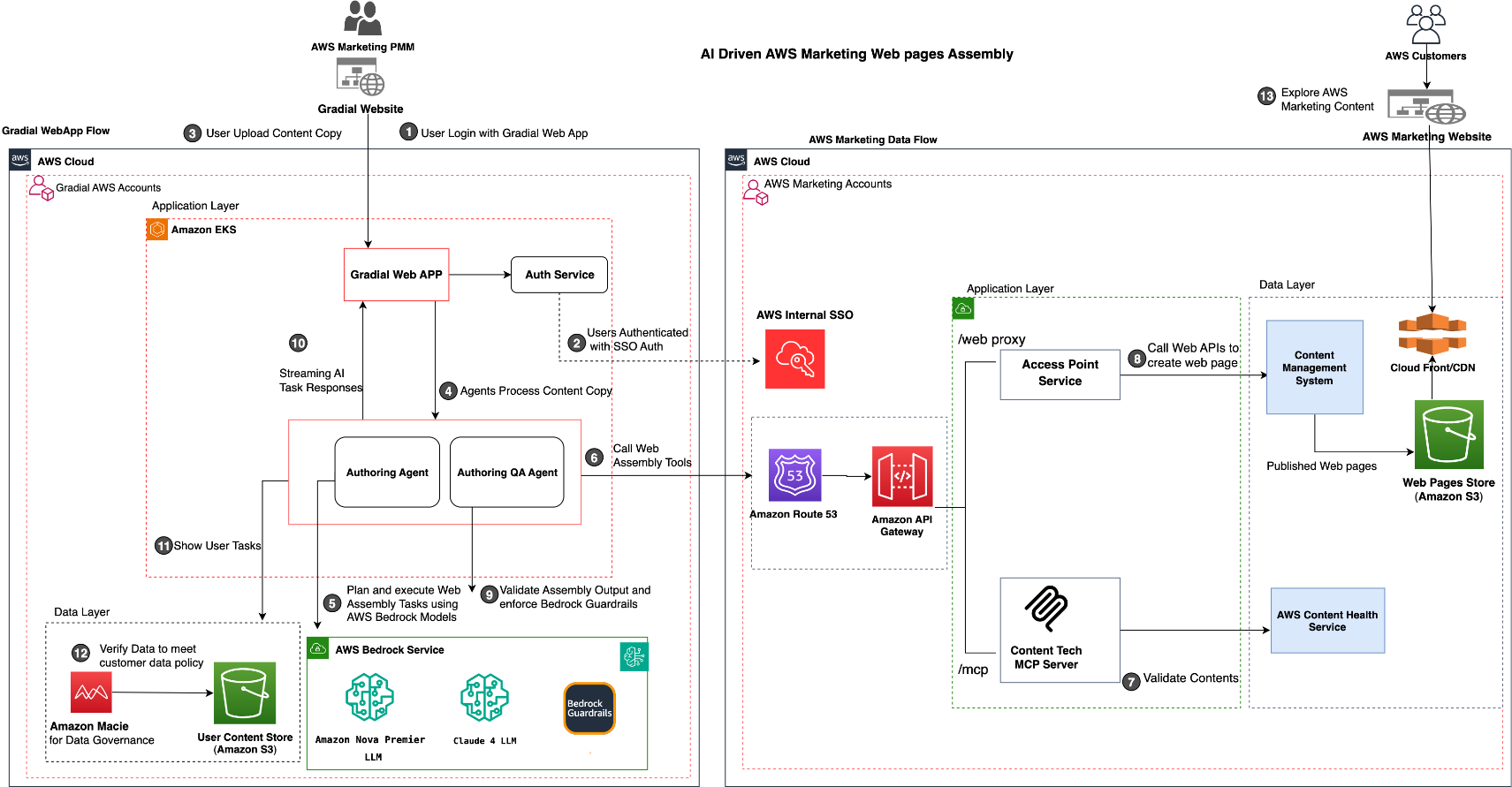
The following diagram shows the end-to-end workflow, illustrating how a plain language requests moves through model interpretation, data validation, and page execution.
This pipeline converts natural language page assembly instructions into production-ready page assets through four automated stages. First, Gradial uses Amazon Bedrock models to interpret the natural language input and identify required components. Gradial Agents then orchestrate page structure, component selection, and layout configuration. As this happens, the MCP server validates content against quality standards in real-time. Finally, the proxy layer creates and configures the page within the CMS.
Results and impact
After deploying the solution into production, the AWS Marketing saw measurable improvements when comparing pre and post implementation:
| Metric | Before | After |
| Page assembly time | Up to four hours of manual build | Down to approximately ten minutes (95% reduction) with natural language commands |
| Quality validation | Reactive and delayed quality review | Proactive real-time quality review |
| User experience | Multi-step and manual with complex setup | Intuitive natural language interface and commands |
Marketing teams can now invest their time in content strategy and optimization rather than technical assembly, accelerating time-to-market for high-impact campaigns. Content validation now happens during content creation instead of after. The MCP server identifies issues as components are assembled so problems can be resolved in the same session, alleviating repeated review cycles and accelerating the time to publish.
Conclusion
By integrating Gradial’s Agentic AI solutions with Amazon Bedrock, organizations can modernize their content publishing workflows and achieve measurable business impact. The solution delivers three key outcomes. First, it enables faster production by reducing page assembly time through automated component configuration and layout generation. Second, it provides quality assurance at the source through real-time validation during assembly that verifies content meets standards before publication, resolving issues before stakeholder review. Third, it creates an accessible authoring experience that replaces complex CMS interactions with natural language input, so more team members can build and publish pages without specialized training. This combination of speed, quality, and accessibility demonstrates how agentic AI on Amazon Bedrock can modernize enterprise content operations while maintaining the governance and compliance standards that marketing organizations require.
Next steps
- Explore the product: Learn about Amazon Bedrock capabilities for building Agentic AI solutions
- Get technical: Visit the Amazon Bedrock documentation to start building
- See it in action: Visit Gradial to learn more about content execution workflows or request a demo to see it live
- Discuss your use case: Contact AWS to explore how Amazon Bedrock can transform your workflows
About the authors